
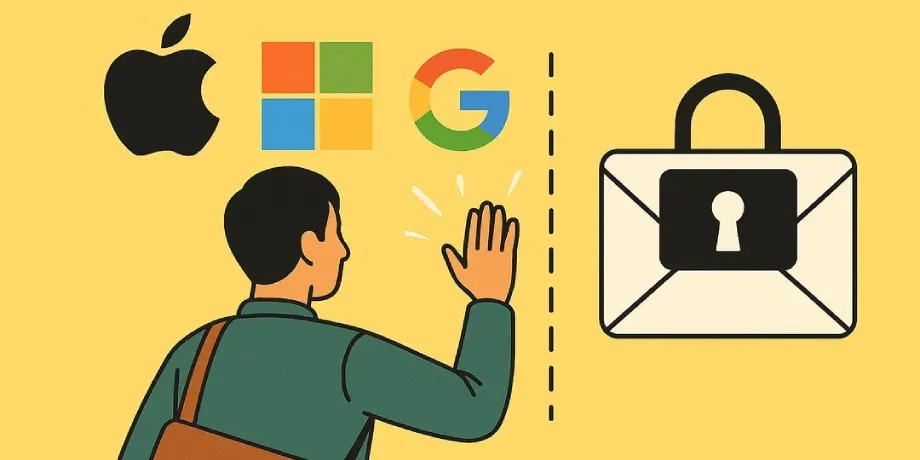
Email Isn't Free. Here's What It Costs.
The "Free" Email Trap
Gmail, Outlook, and Apple iCloud Mail dominate the consumer market. In 2025 it feels almost dystopian to imagine a user who doesn't rely on one of these services. Their popularity isn't accidental - each is baked into the operating-system ecosystems we use daily.
- Android phones require a Google account.
- Windows prompts (and often forces) a Microsoft account.
- iOS/macOS nudges you toward an Apple ID.
When you pick an OS, the platform automatically suggests its native mail client, making the associated email service the path of least resistance. And the best part? The email itself is "free." In reality, the cost of storing billions of inboxes is covered by the companies' broader business models.
How the "Free" Model Works
Take Gmail as an illustration. If we assume it costs roughly $3 per user per year to store 2–5 GB of mail (the average usage is well below the 15 GB cap), then with ~1.8 billion active accounts the expense would be about $5.4 billion annually. That's a massive subsidy, funded not by governments but by the companies' primary revenue streams.
Google Gmail
Launch: 2004
- Advertising & profiling: From 2004–2017, Gmail scanned email content to deliver contextual ads. Post-2017, scanning stopped; ad targeting now draws on broader Google Account data (search history, YouTube activity, location, demographics). Google also relies on native Gmail ads - sponsored messages that appear in the Promotions tab looking like regular emails.
- Google Workspace (paid Gmail): Enterprises and power users pay for custom domains, expanded storage, advanced security, and admin controls.
- Google One storage upgrades: Free accounts share 15 GB across Google services. Once that quota is exceeded, users purchase additional storage - a steady revenue stream.
Microsoft Outlook / Hotmail
Launch: Hotmail (1996) → Outlook.com (2013)
- Advertising: Microsoft does not scan email content for ads. Instead, ads are displayed in the web and app interfaces, targeted using Microsoft Account data and Bing activity.
- Microsoft 365 subscriptions: Users can upgrade for premium mailbox features, larger storage, and the full Office suite.
- Enterprise & government contracts: Outlook.com runs on the same Exchange/Office 365 backbone that powers paid business and governmental deployments. Those contracts subsidise the free consumer tier.
Apple iCloud Mail
Launch: 2011 (as part of iCloud)
- iCloud+ subscriptions: The service is ad-free. Paid tiers add extra email storage, "Hide My Email," custom domains, and enhanced privacy tools.
- Hardware ecosystem: iCloud Mail deepens reliance on Apple devices, encouraging hardware sales and reinforcing brand lock-in.
- Broader Services segment: While iCloud Mail itself isn't directly monetised, it contributes to Apple's overall Services revenue (App Store, Apple Music, TV+, etc.).
Privacy & Legal Considerations
US Government Access to Data
If your email is stored on servers in the United States, the government can compel the hosting company to turn over the contents of those messages. Between 2016 and 2020 Microsoft fought a US Department of Justice subpoena seeking access to emails in a Microsoft data centre in Ireland - a high-profile illustration of how US law enforcement tries to reach data stored abroad. The dispute helped shape the interpretation of the CLOUD Act (2018), which clarifies that US authorities may request data from American companies even when the data physically resides overseas.
PRISM / NSA Program (2013)
Edward Snowden's 2013 leaks exposed a secret surveillance programme known as PRISM, under which US intelligence agencies obtained bulk access to user data from several major tech firms via classified FISC orders. The documents showed Google, Microsoft and Yahoo handing over large volumes of email and other communications, while Apple's involvement appeared comparatively limited.
Microsoft Code-Leak Incident (2014)
In 2014 Microsoft admitted that its security team accessed an Outlook.com inbox without a warrant - a power normally reserved for law-enforcement agencies. Microsoft justified the intrusion by citing its terms-of-service provisions, but the episode sparked public backlash and raised questions about corporate authority to bypass judicial oversight.
Google Scanning Email Content for Ads (2004–2017)
From its launch until 2017, Gmail automatically parsed the text of every incoming message to generate contextual advertisements. The approach prompted a series of legal challenges. Google then discontinued email-content scanning for ad targeting, shifting instead to profile-based advertising derived from broader account activity.
Student Data and Education Gmail (2014–2015)
Google was caught scanning student and teacher Gmail accounts in Google Apps for Education for ad profiling. Google admitted in court filings that it scanned and processed student emails for purposes beyond spam filtering.
For journalists, lawyers, officials, or anyone handling sensitive information, these realities matter.
What Alternatives Exist in 2025?
Non-encrypted, privacy-focused providers
- Posteo (Germany): €1/month
- mailbox.org (Germany): €1/month
These services don't sell data for ads, but they still process mail on the server side (e.g., spam filtering) and remain subject to local legal demands. Choosing a European host offers stronger data-protection laws than US jurisdictions.
End-to-end encrypted email
- Proton Mail (Switzerland): Free (limited). Paid from $4.99/month.
- Tuta Mail (Germany): Free (limited). Paid from €3/month.
- Mailfence (Belgium): Free (limited). Paid from €2.50/month.
With true end-to-end encryption, the provider never sees the plaintext content, dramatically reducing exposure to surveillance or data-breach risks.
Self-hosting
Running your own mail server is technically possible but comes with significant responsibilities around maintenance and security. For most users, a reputable third-party provider remains the safer, more practical choice.
Choosing the Right Path
You could get by using the limited free version of Proton for most purposes and then pay if you need more features. You might think it's crazy to pay for email, but the fee buys you privacy, legal safeguards, and peace of mind that your correspondence stays out of corporate hands. A takeaway coffee costs more per month than the services mentioned above if privacy is important to you.
The good news is that in 2025 the landscape is richer than ever. The key is to align the level of privacy you need with a service that matches both your budget and your threat model.
Bottom line: "Free" email is subsidised by advertising - in many cases unethical - and there is a real risk of privacy invasion by companies and governments using your data for purposes you might not be aware of. If you value your privacy, consider switching to a provider that keeps your data out of corporate hands.


